It’s an important question. And probably not discussed frequently enough.
After your first session with your counselor, you may feel a bit of relief after just sharing what’s been going on with you, knowing that there’s someone you can talk to that you have permission to open up about pretty much anything.
Sometimes clients have expectations about how much counseling should help that are a little unrealistic. It pains me to say it, but just talking about your feelings and what’s going on in your life in session isn’t going to change much about how you’re feeling. Counseling isn’t a discrete thing that happens to you once a week- it should be applied to your life. There are 168 hours in a week, and typically clients meet with a counselor for only one of those hours. The other 167 hours and what you do with it are up to you- so if you haven’t looked into the book, the worksheet, the reading, the meditation, the song, or the journaling that your counselor is suggesting in the other hours of the week, it will be hard to begin to build the habits needed to change.
Adjusting your expectations of therapy includes seeing yourself as having the most power in your own change, and seeing your counselor as a guide, as someone to check in with and who understands you and truly wants what is best for you. Not a magical resource that makes things better.
This is backed up in the research- the largest contribution of change comes from the client. However, a counselor still brings to the table a significant part. Here is the breakdown (for reference: Asay & Lambert, 1999; Lambert & Ogles, 2004)
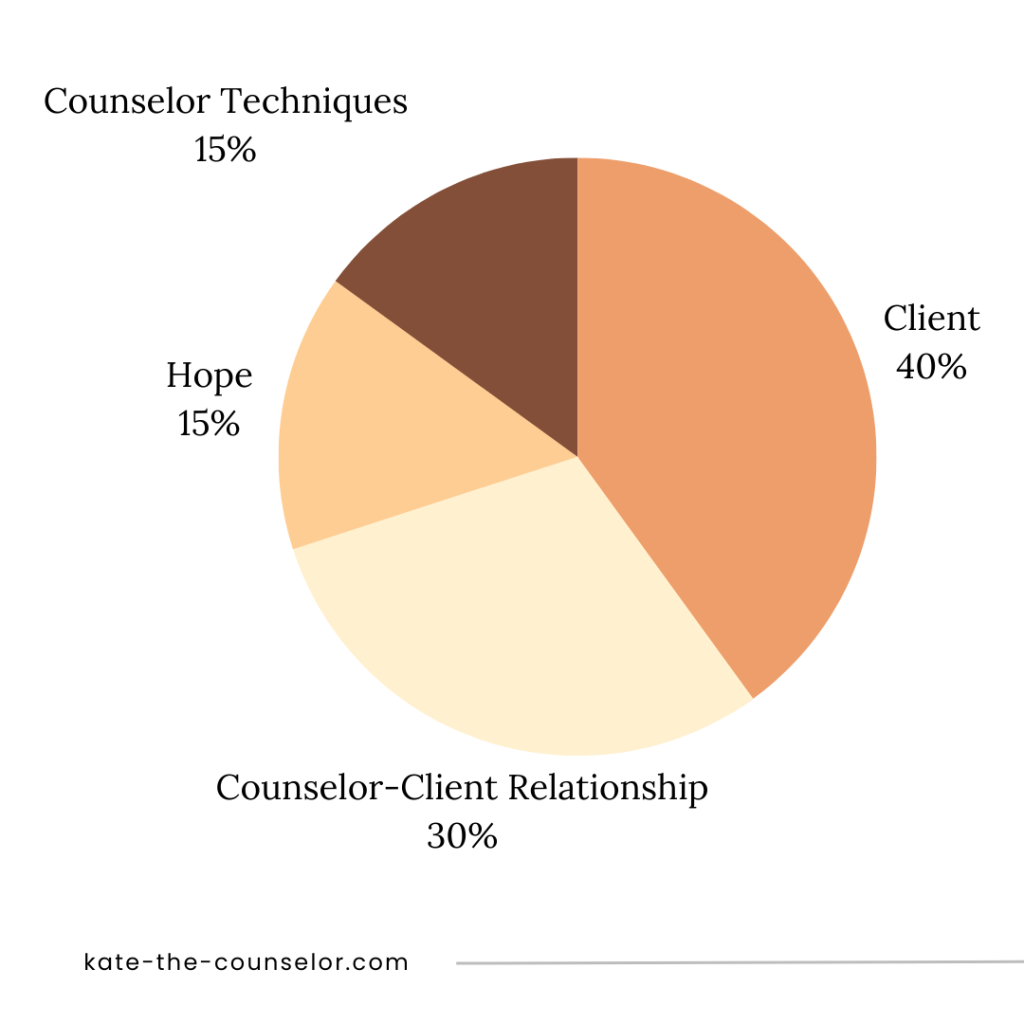
40%– The largest contributor of client change is what the client themselves bring in to counseling. Your personal strengths, values, supports, resources, and willingness. What you do in between session truly does matter, and this makes sense it’s the largest piece. It would be a bit concerning if it wasn’t!
30%– The relationship between client and counselor. Having a great relationship with your counselor can help you feel accepted, validated, respected and heard. This caring space is hopefully helping you make some room to examine your life honestly. Sometimes the way a counselor cares for a client is one of the first exposures of this kind. So it is rather important that you like your counselor and feel safe sharing things with them.
15%– The amount of hope that the client brings into the relationship. Oh, the power of belief. It makes me sad to see the self-fulfilling prophecy played out when someone believes they are a lost cause, or that they’ve tried so many things and that nothing will work. If you don’t see your humanity and your goodness, that’s okay. A lot of us do not. Notice that this is not the most significant % category. Your experience with your counselor and putting in the work may gradually increase your levels of hope before you even realize you are ready to believe you’re capable of change.
15%– The theory and techniques used by the counselor. Each counselor tends to gravitate toward theoretical orientations and certain client issues are better suited for certain techniques. For example, I say that the theory I am generally most guided by is humanistic theory (also called Rogerian or person-centered.) Instead of being super distant, professional, and clinical, humanistic counselors show who they are, are genuine, believe and understand their thoughts, feelings, and experiences (like I am asking you to do), and can give you feedback in real time about what they are experiencing in our relationship (to a therapeutic extent). However, depending on your issue is coming into counseling, this might not be the best approach for you.
So back to the question: when will I feel better? There is no one size fits all timeline, but if you are putting in the work within about a month (21 days makes a habit they say) you should probably start feeling some relief. However, often there are several concerns in therapy to work through and so the recommended time in one-on-one sessions is 3 months.
In summary, therapy is one way to make a commitment to your mental health, and your therapist has a huge toolbox with which to help you. But those tools are only useful if you adopt them in the moments of distress you’re having day to day.
 Katheryn Kiker
Leave a comment