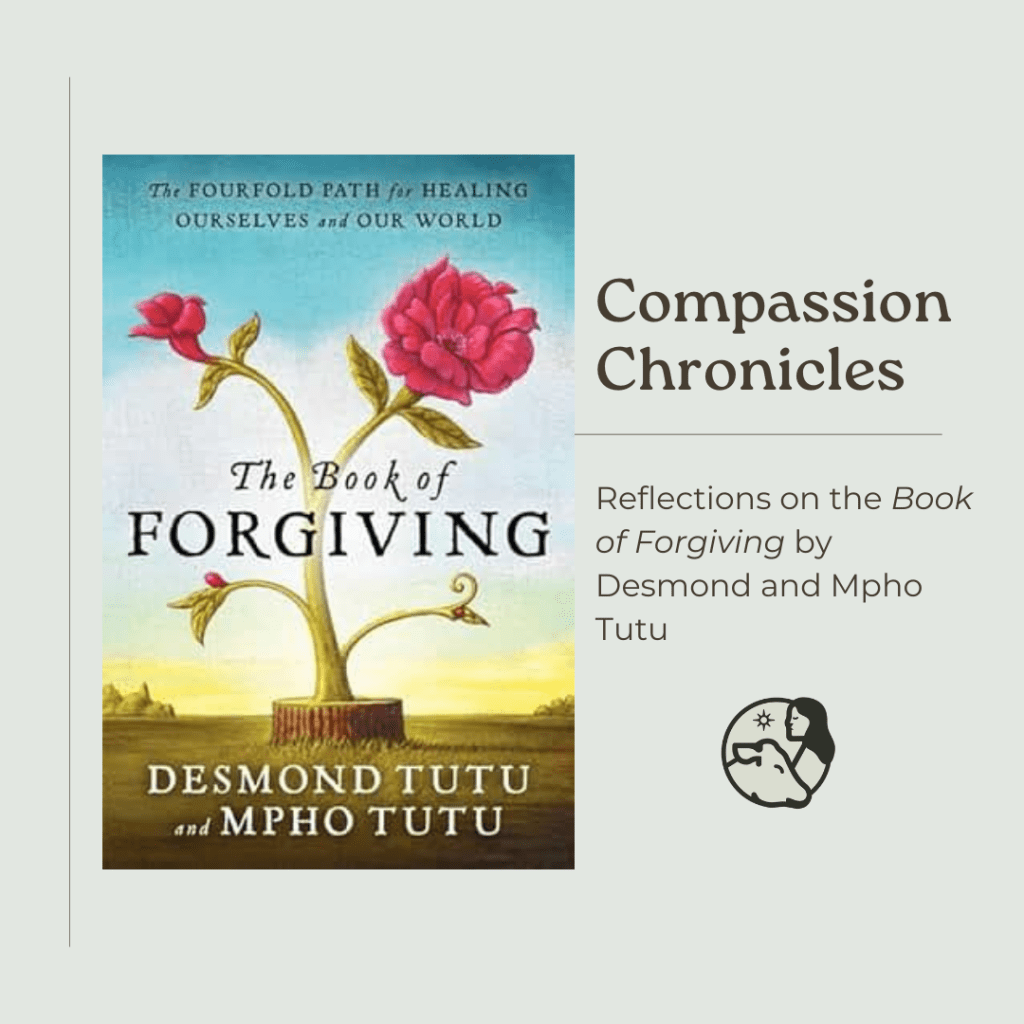
The Book of Forgiving– The Fourfold Path for Healing Ourselves and Our World, by Desmond and Mpho Tutu is a book I have had on my shelf for many years. I would read a few chapters, and then put it back. Not because it wasn’t good, quite the contrary. It’s because as I read about how to forgive, I was going on my own journey. I wasn’t ready to forgive all at once. As a counselor I also recommend this book- on top of the reading it has so many great reflections and exercises for those who are ready to go on the forgiveness journey.
A good reason to forgive is that we are tied to how others treated us in the past without it. Even when we find people who are considerate and kind, we don’t receive their goodness because it touches the place where we are still in pain. We believe how others treated us in the past is a reflection of who we are, and behave in ways that end up ultimately hurting ourselves.
So what is forgiveness? According to the authors, it is a process where you first address your own pain, tell your story, recognize the humanity in the other person, and then decide to renew or release the relationship.
Tending to our own pain is an absolute first requirement.
Notice if we try to understand the perpetrator of our hurt before we have looked at our own, it is not true forgiveness. In fact, this is a description of how victims of relational abuse continue with the relationship.
This part where we address our feelings and acknowledge our pain is sometimes where people stay. It is indeed easier to blame others for how we feel and we can continue to do so for a lifetime. However, after we’ve been hurt, the pain actually lives on inside of us and working on it is the only way for us not to be defined by our past.
It seems very unfair. We are hurt by others, it is not our fault. But the inescapable fact is that the hurt is under our skin and becomes our job to heal it. It is a law and a paradox of humanhood.
We know this is true. Even if the person who hurt us makes a thousand attempts to make it all better, it doesn’t work if we haven’t acknowledged the pain inside us first. In fact, we often want to push them away the more they do it, and feel their attempts are ingenuine. And it’s because we can’t see them as genuine at this point- we have to first heal from the inside.
Telling your story to someone you trust, or even writing it down, can help you reckon with what happened.
You were hurt in a reality that exists in space and time and these facts perhaps were not acknowledged by anyone else. Sometimes we need the help of a counselor, like in instances with trauma where we are very confused about our role in our own pain and have taken too much responsibility. It is more than okay to get help sorting it out.
Seeing the Humanity in Others
One of the most harmful aspects of human tendency that has caused so much pain to our world is to begin to see someone as not human or “other.” This is how perpetrators rationalize abuse – they don’t see the victim as feeling, as human. They see them less than themselves. This happens culturally as well, with racism, sexism, and classism. A lot of the -isms are derived from people believing a group of people have less humanity than they do because of a certain quality about them that they have justified.
Sometimes we start to do this in small ways in our relationships when we have been hurt. Our resentment lets us treat the person we are mad at with coldness or anger over and over again, often for the same offense.
So when we go on the path of forgiveness and acknowledge our own pain, we then have an opportunity to extend understanding to the person who hurt us. This is not exactly easy, and it is not something to force, but to practice offering them compassion. Fear is one of the strongest emotions, one that our minds go to rather quickly so that we can protect ourselves from being hurt again. And viewing the other person as someone that is evil or can’t possibly be understood is a way to ensure our protection. Opening our minds and our hearts to the possibility of their humanity, knowing the truth that they would not hurt another unless they were misguided, in pain, ignorant. That “they know not what they do.”
Deciding to Renew or Release
Forgiveness does not look a certain way. It doesn’t mean we want to see the other person again, or that we give them an opportunity to acknowledge what they’ve done. We get to decide what relationship we have with the other person, what is safe for us.
For example, there are people who have been affected by individuals who were violent and unreasonable in the past, who became their abusers. Just because the individual has decided to go through the process of forgiveness, does not mean that there should be any sign that they should renew the relationship, and it may be more wise to release it.
Final Thoughts
Forgiveness is a part of the internal work needed to maintain healthy human relationships. It is one of the keys that lets us live with our hearts open, no matter how many times we’ve been hurt.
I find the work of counseling naturally contains the steps of forgiveness. First, we express our pain and experiences to our counselor. Then the counselor helps us sort out the beliefs we have about ourselves that may have been from our past that we harm ourselves with over and over by seeing ourselves in a certain way. Then as we have changed our internal lives and shifted how we see ourselves, we then have a choice to change our external lives.
My hope is that we all take up the work of tending to what keeps us separate or feeling alone. Forgiveness says: I matter, what happened matters, but because I know it matters I don’t need to hold onto any hatred or bitterness. I may have lost something to this experience but I am still here and can keep opening my heart.
I will leave you with a quote in this book that has the most gravity for me and that I reflect on again and again:
“The quality of human life on our planet is nothing more than the sum total of our daily interactions with one another.”
-Desmond & Mpho Tutu
Resources From the Book:
Forgiveness story websites
http://www.theforgivenessproject.com
http://www.forgivnessfoundation.org
http://www.projectforgive.com
Anonymous apology websites
http://www.perfectapology.com
http://www.imsorry.com
http://www.joeapology.co
Hotline number: 347-201-2446
 Katheryn Kiker
Leave a comment